Why AI is relevant to HVAC now
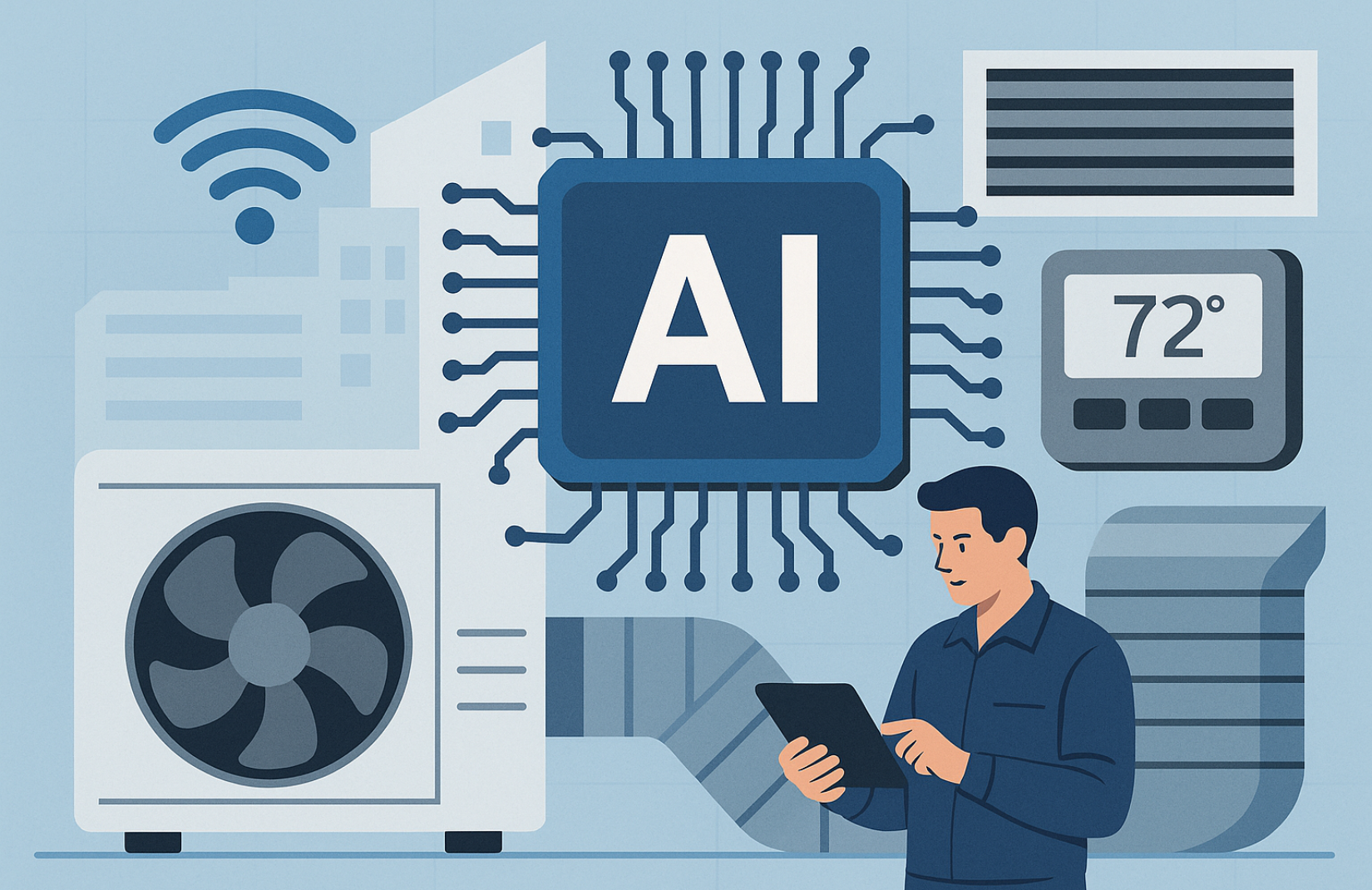
The built-environment world is undergoing a digital transformation. As buildings become smarter — with more sensors, Internet-of-Things (IoT) integration, and building automation — there’s growing potential to apply AI and machine-learning tools to HVAC systems.
For decades, HVAC design and operation relied on fixed rules, periodic manual maintenance, and reactive troubleshooting. But AI changes the paradigm: instead of just reacting, systems can learn, predict, and adapt. As described in a recent ASHRAE-journal article, AI can make buildings operate more energy-efficiently, sustainably, and comfortably.
Moreover, the push toward decarbonization, building lifecycle efficiency, and sustainable operations — topics frequently discussed at ASHRAE conferences — makes AI-driven HVAC solutions more timely than ever.
Main Applications of AI in HVAC & Built Environments
Here are some of the core ways AI is being used (or explored) in HVAC and building systems:
- Building performance optimization & energy management
AI can continuously monitor building sensors, occupancy data, weather forecasts, and system loads to optimize HVAC operations — potentially reducing energy waste without compromising occupant comfort. - Fault detection & predictive maintenance
Rather than waiting for a technician to find a broken component, AI (especially via machine-learning / deep-learning) can detect anomalies, diagnose faults, and even predict failures before they happen. This helps avoid downtime and can significantly reduce maintenance costs. - Digital-twins & virtual commissioning
By integrating data from building information models (BIM), IoT devices, and automation systems, AI can help build a “digital twin” — a virtual replica of the building and its HVAC systems. This makes design, simulation, commissioning, and ongoing operations far more efficient. - Improved customer service and business operations in HVACR sector
For contractors, service providers and manufacturers, AI and smart digital tools are reshaping how they serve customers: faster diagnostics, remote monitoring, predictive maintenance contracts, more efficient load forecasting, and optimized supply chains.
Benefits — What’s in It for Stakeholders
Here’s how different stakeholders benefit from AI-powered HVAC innovations:
✅ For Building Owners & Facility Managers
- Lower energy bills — AI’s optimization of HVAC cycles and load can lead to substantial energy savings over time.
- Reduced maintenance costs and fewer breakdowns — predictive diagnostics and early fault detection can extend equipment lifespan and avoid expensive failures.
- Better occupant comfort — AI can respond dynamically to occupancy patterns, climate variations, and building usage, improving indoor comfort and air quality.
✅ For HVAC Contractors, Technicians & Manufacturers
- More efficient, proactive service — AI tools provide real-time insights, reducing time spent on site visits, manual checks, or guesswork.
- Recurring revenue opportunities — predictive maintenance contracts, monitoring-as-a-service, or remote management become possible business models.
- Competitive differentiation — early adopters of AI-driven HVAC offerings can stand out in an industry increasingly focused on smart buildings and sustainability.
Looking Forward: Why AI Is Likely the Future of HVAC
Given global emphasis on energy efficiency, sustainability, and smart infrastructure — and the increasing availability of data, IoT, and cloud computing — AI is uniquely positioned to transform HVAC from a largely mechanical discipline into a data-driven, intelligent operation.
As buildings become smarter and more connected, AI-powered HVAC systems will increasingly deliver operational savings, improved comfort, reduced maintenance headaches, and environmental benefits — making them attractive not just for large commercial buildings, but also for residential, institutional, and industrial settings.
For HVAC professionals and companies, embracing AI now could mean not just evolving along with technology — but leading the transformation of the entire industry.